Biggest Hisense U65Qf Mini Led Tv Buying Mistakes (And How to Avoid Them)
Introduction
The Hisense U65Qf Mini Led Tv sits in a crowded market segment where picture quality, features, and price meet real-world expectations. For many shoppers, the promise of mini‑LED backlighting — deeper contrast, brighter highlights, and cleaner local dimming — is compelling. However, buying the wrong model, misunderstanding specs, or misconfiguring the set at home can leave a buyer disappointed despite an otherwise capable television. This article outlines the most common buying mistakes associated with the Hisense U65Qf Mini Led Tv and provides practical, non‑technical advice to avoid them. The goal is to help readers match this TV to real use cases such as movie nights, gaming, sports viewing, and everyday streaming.
Product overview and context
The Hisense U65Qf is marketed as a Mini‑LED option in the U‑series lineup — a family known for combining high brightness and local dimming with competitive pricing. Mini‑LED is a backlight technology that uses many small LEDs behind the LCD panel to create more precise dimming zones, improving perceived contrast compared to traditional edge‑lit LED TVs. For buyers, that translates into stronger HDR performance in many scenes and reduced blooming around bright objects on dark backgrounds.
Before diving into mistakes, it's important to frame expectations: the U65Qf aims to deliver strong HDR highlights, respectable black depth for an LCD, and value for money. It is not an OLED, and it will behave differently in very dark rooms and at extreme viewing angles. Understanding what the set is designed to do — and what it is not — helps avoid regret after purchase.
Detailed product review and analysis
Picture quality and Mini‑LED behavior
The most visible benefit of the U65Qf is the improvement that mini‑LED brings over conventional edge‑lit LCDs. Viewers can expect brighter specular highlights (useful for HDR content such as sun glints and explosions) and more controlled blooming thanks to many local dimming zones. However, these gains depend heavily on how the TV is set up: default picture presets are often tuned for showroom brightness and saturated colors, which can exaggerate contrast and make content look artificial.
Real‑world takeaway: for movie fans who value deep blacks in dim rooms, mini‑LED reduces the penalty of LED glow but doesn't eliminate the fundamentally different black level behavior compared to self‑emissive OLED. Users who prioritize absolute black should compare side‑by‑side in the intended viewing environment.
HDR handling and tone mapping
The U65Qf generally handles a range of HDR material well, delivering punchy highlights on supported content while maintaining mid‑tone detail. Tone mapping — how the TV maps HDR peak brightness to its panel capability — varies with firmware and presets. Buyers should check for an HDR picture mode and test with a variety of HDR trailers or streaming content to see how aggressive the tone mapping is.
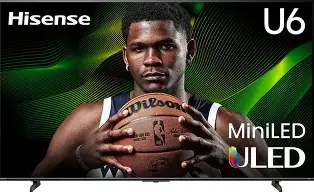
Real‑world takeaway: very bright rooms benefit from the U65Qf’s higher peak brightness, but in dim rooms the tone mapping and local dimming settings need attention to avoid crushed shadows or blown highlights.
Motion, gaming, and responsiveness
Many buyers use a single TV for multiple purposes. The U65Qf typically provides gaming‑friendly features such as a dedicated game mode that reduces input lag, and often supports variable refresh rate (VRR) and auto low latency mode (ALLM) depending on region and HDMI configuration. These features matter for modern consoles and gaming PCs.
Real‑world takeaway: buyers pairing the TV with a current-generation console should verify HDMI bandwidth and VRR support. Expect good but not necessarily top‑tier performance compared with specialist high‑refresh gaming panels.
Smart platform, apps, and updates
Hisense deploys different smart platforms in various regions — for example, VIDAA or Google TV on some U‑series models. The choice of platform affects app availability, voice assistant options, and the user interface. Firmware updates can improve performance over time, but availability and frequency vary.
Real‑world takeaway: confirm the smart OS in the retailer's region and check for key streaming apps used by the household. If a particular app or ecosystem is essential, verify it will run on the intended platform.
Find top-rated TVs & Home Theater products at great prices.
See Deals →Audio, design, and ergonomics
On‑board speakers in flat TVs typically prioritize space and style over immersive sound. The U65Qf will likely handle dialogue and everyday TV audio well, but movie fans and audiophiles should plan for a soundbar or external audio system. Design and stand width also matter: check stand spacing and VESA mount compatibility before purchasing if the TV will sit on a console or wall bracket.
Real‑world takeaway: households with shallow cabinets or limited space should measure stand width and VESA hole pattern first; costly returns are an avoidable annoyance.
Common buying mistakes (and how to avoid them)
Mistake 1: Expecting OLED black levels from a Mini‑LED LCD
Why it happens: marketing highlights “deep contrast” and “mini‑LED” without clarifying the distinction between self‑emissive and backlit technologies.
How to avoid it: compare side‑by‑side in a dim room if deep blacks are a priority. Accept that mini‑LED greatly narrows the gap but will not match OLED’s pixel‑level dimming. If absolute black is essential, prioritize OLED; if high brightness and local dimming are more important for bright rooms, mini‑LED is a sensible choice.
Mistake 2: Not checking HDMI specs for console use
Why it happens: product listings often list “HDMI” without specifying the version or bandwidth features required for 4K/120Hz VRR gameplay.
How to avoid it: verify the number of HDMI 2.1 ports, or whether the HDMI ports support the bandwidth and gaming features needed (4K@120Hz, VRR, ALLM). If the U65Qf has limited HDMI 2.1 capability, plan for an external HDMI switch with passthrough or accept 4K@60Hz for some devices.
Mistake 3: Buying without measuring the room and placement
Why it happens: shoppers focus on screen size and price but forget stand width, wall depth, and viewing distance.
How to avoid it: measure the intended space, confirm VESA mount compatibility, and calculate optimal viewing distance for a 65‑inch screen (rough reference is 1.2–2.5 times the diagonal depending on viewing preference). Ensure the stand fits the furniture or budget for a low-profile wall mount.
Mistake 4: Relying on default picture presets
Why it happens: stores show TVs in “vivid” or “game” modes to impress shoppers, and buyers leave the presets unchanged at home.
How to avoid it: switch to “movie” or “cinema” mode for film content, and run basic calibration (brightness, contrast, color temperature) or download a preset from a reputable calibration guide. If color accuracy matters, consider a one‑time pro calibration or using built‑in picture settings recommended by reviewers.
Mistake 5: Underestimating audio needs
Why it happens: thin TVs are visually appealing and buyers assume built‑in speakers are “good enough.”
Looking for the best TVs & Home Theater deals on Amazon?
See Deals →How to avoid it: budget for a soundbar or compact AV receiver if the household watches movies, sports, or streams concerts. Even an affordable soundbar significantly improves dialogue clarity and perceived bass depth.
Pros & Cons
- Pros
- Mini‑LED backlight improves contrast and reduces blooming compared with edge‑lit panels.
- High peak brightness suits bright rooms and HDR highlights.
- Often includes gaming features such as low input lag and VRR support.
- Competitive value for the combination of picture technology and features.
- Cons
- Not true self‑emissive black levels; some blooming can remain in high‑contrast scenes.
- Default picture presets may be oversaturated or overly bright out of the box.
- Smart platform and firmware behavior vary by region; app availability differs.
- Internal speakers are limited compared to a dedicated audio setup.
Comparison table — Hisense U65Qf vs. alternatives
| Model | Panel / Backlight | HDR Formats | Smart OS | Best for | Price Tier |
|---|---|---|---|---|---|
| Hisense U65Qf Mini Led Tv | IPS/VA LCD with Mini‑LED backlighting | Common HDR formats (Dolby Vision, HDR10; availability varies) | VIDAA or Google TV (region dependent) | Bright‑room HDR viewing, general use, mixed gaming | Mid‑range |
| Hisense U7 / U8 Series (Mini‑LED variants) | Mini‑LED with enhanced local dimming | Dolby Vision, HDR10+ | Google TV / VIDAA | Higher brightness and contrast control, step up in HDR | Upper mid‑range |
| Samsung Neo QLED (e.g., QN90 series) | VA with Mini‑LED / Quantum HDR | HDR10, HDR10+ | Tizen | Excellent bright‑room performance, gaming features | Premium |
| LG QNED | IPS/VA with Mini‑LED + Quantum Dot (depending on model) | Dolby Vision, HDR10 | webOS | Balanced performance, wide viewing angles (on IPS) | Premium / Upper mid‑range |
Buying guide — what to check and how to decide
1. Clarify the primary use case
Buyers should list how the TV will be used: movies in a dark living room, bright living room sports, competitive gaming, or general streaming. The optimal settings and the importance of features such as absolute black levels, peak brightness, and input latency change with the use case.
2. Check HDMI and gaming features
Look for explicit mention of HDMI 2.1 (or equivalent feature support) if using a PS5, Xbox Series X, or a PC GPU at 4K/120Hz. Verify support for VRR, ALLM, and sufficient HDMI bandwidth on the ports you plan to use. If the product listing is unclear, ask the retailer or check the manufacturer’s spec sheet.
3. Evaluate the smart platform and apps
Confirm the U65Qf in the intended market runs the preferred smart OS and supports essential streaming services. If a household relies on a niche app or on a particular voice assistant, verify compatibility before buying.
4. Measure the installation area and plan for audio
Measure TV dimensions including stand width and check the VESA pattern for wall mounting. Decide whether a soundbar or AV system will be part of the purchase and plan the budget accordingly.
5. Inspect return policy and warranty
Buy from a retailer with a reasonable return window and read the warranty terms. Television replacements or service visits can be time consuming; solid return policies reduce risk if a unit has uniformity issues or defective zones.
6. Test in‑store if possible, but prioritize at‑home testing
In‑store demos are useful for comparing color and motion, but store settings are often maximized for shelf impact. If possible, buy from a retailer that allows a home trial period so settings and features can be tested in the actual viewing environment.
7. Account for firmware and future proofing
Check the manufacturer’s record for delivering firmware updates. A TV that receives occasional updates can improve app performance, fix bugs, and occasionally improve picture tuning over time.
Practical setup and calibration tips
- Switch presets: Move to "Cinema" or "Movie" mode for film, "Game" mode for console play, and "Standard" for general TV. These modes balance color, brightness, and processing differently.
- Adjust local dimming: If local dimming appears too aggressive (crushing shadow detail) or too weak (noticeable blooming), try the different local dimming levels in the picture menu.
- Turn off excessive motion smoothing: Motion interpolation can create the “soap opera effect” for movies; disable it for cinematic content and enable a lower setting for sports if desired.
- Use the right HDMI port: Ensure devices that need high bandwidth are connected to ports that support the required features (labelled on many sets).
- Speaker settings: If using external audio, set TV audio output to HDMI ARC/eARC or optical depending on the sound system to avoid lip‑sync issues.
Conclusion
The Hisense U65Qf Mini Led Tv represents a strong value proposition for buyers seeking brighter HDR performance and improved contrast over traditional LED models. Common regrets stem less from the hardware itself and more from mismatched expectations, overlooked connectivity requirements, and poor out‑of‑the‑box configuration. By checking HDMI features, confirming the smart platform, measuring installation space, planning for audio, and adjusting picture settings for the viewing environment, buyers can avoid the most frequent mistakes and get the best performance from the U65Qf. With a bit of preparation and the right setup, the television delivers compelling everyday performance for movies, sports, and gaming.